
A certified-mail envelope arrives from your mortgage lender. Maybe you’ve been avoiding the mailbox. Maybe you’re hoping it will work itself out.
Here’s what you need to understand right now: Texas foreclosure is fast — one of the fastest in the country. From the first notice to the auction on the courthouse steps, the entire process can legally happen in as little as 41 days.
That’s not a scare tactic. It’s the law. And it means that in Texas, understanding the timeline is your best defense. Every day matters, every notice matters, and the options available to you shrink as the calendar advances.
In this guide, I’ll break down the Texas foreclosure process step by step: what triggers it, the two critical notices you’ll receive, the “First Tuesday” rule, the only reliable ways to stop the clock, and what happens after a sale — including deficiency judgments and surplus funds many homeowners never knew they were owed.
Watch the Video
Prefer to watch instead of read? Watch Attorney Hamilton Rucker explain this issue in detail here:
▶ Watch on YouTube: The Texas Foreclosure Timeline Explained by a Texas Real Estate Attorney
In this video, Attorney Hamilton Rucker covers: why Texas foreclosure moves so fast, the Notice of Default and Notice of Acceleration, the 41-day minimum timeline, the First Tuesday auction, the three ways to stop a foreclosure, and your rights after the sale.
Texas Moves Fast: The “Non-Judicial” Process
In many states, a lender must sue the borrower and win in court before foreclosing — a “judicial foreclosure” that can take a year or more.
Texas is different. Most Texas foreclosures are non-judicial: handled entirely outside the court system under Chapter 51 of the Texas Property Code and the terms of the deed of trust you signed at closing. No lawsuit. No judge. That’s why the timeline is so compressed.
Three things define the Texas system:
- No court suit needed. The lender doesn’t sue you to foreclose; the process runs on notices and deadlines.
- The power of the trustee. The deed of trust names a “trustee” (often an attorney) with authority to sell the property at auction if you default. The trustee’s power comes directly from the document you signed and the statute.
- Strict rules. Precisely because the process is so fast, the lender must follow every procedural rule and deadline perfectly. Texas courts have held that a trustee’s power of sale requires strict compliance — miss a step, botch a notice, or violate the statute, and the sale can be void or challengeable.
One note: judicial foreclosure still exists in Texas and is required for certain loans — most notably home equity loans, discussed below. But the standard mortgage foreclosure is non-judicial.

What Starts the Clock? Monetary vs. Technical Default
Foreclosure begins with a default — and there are two kinds:
- Monetary default: failing to pay the mortgage. This is by far the most common trigger.
- Technical default: violating a non-payment obligation in the loan documents — most commonly failing to pay property taxes or failing to keep the home insured.
Then comes the review: the lender (and its attorney) examines the loan documents — the note, the deed of trust, the payment history — to confirm a default exists under a specific provision and that the file supports foreclosure. Once confirmed, the timeline begins.
Attorney Hamilton Rucker’s Perspective
Homeowners are often blindsided by technical defaults. You can be current on every mortgage payment and still face foreclosure because the property taxes lapsed or the insurance was cancelled. If you get a letter about taxes or insurance from your lender, treat it with the same urgency as a missed-payment notice.
Step 1: The Warning Shot — Notice of Default
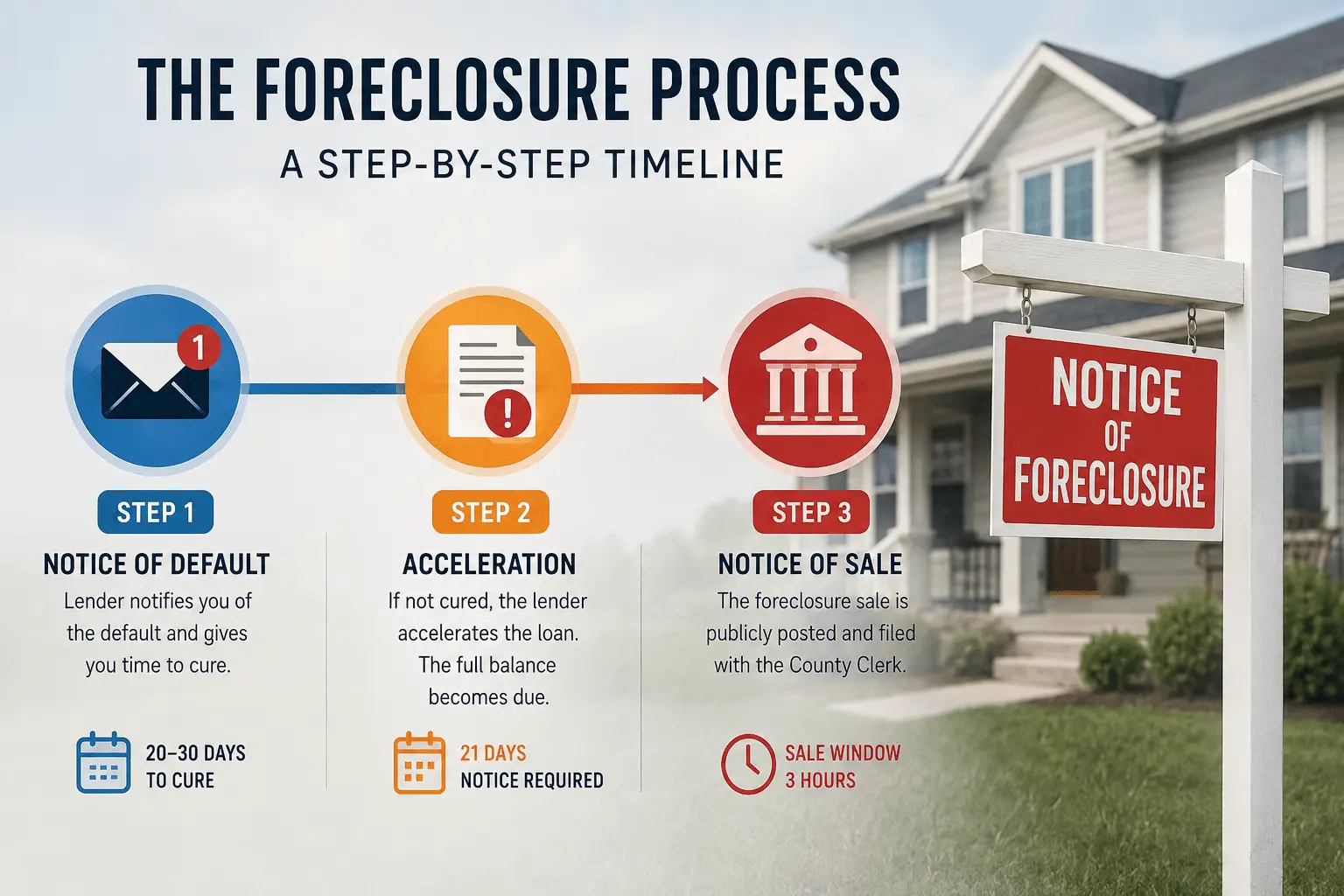
The first formal step is a letter sent by certified mail: the “Notice of Default and Intent to Accelerate.”
What it does:
- Identifies the default and tells you exactly how much you must pay to get back on track — this is your opportunity to cure.
- Sets your deadline. For a homestead, Texas law requires at least 20 days to cure. (If the deed of trust is on the standard Fannie Mae form — most are — you’re entitled to 30 days, and many lenders’ attorneys give 30 days routinely to be safe.)
- Starts the clock on the entire foreclosure timeline.
Crucial tip: the law assumes you received the notice if it was properly mailed to your last known address in the lender’s records. Actual receipt is not required. Refusing the envelope or letting mail pile up does not stop the legal process. Always open your mail — and if you move or your mailing address changes, update the lender in writing.
During this window, you can typically resolve the default by paying only the past-due amount — the missed payments plus allowable fees. That option is about to disappear.
Step 2: Calling the Full Loan Due — Acceleration
If the cure deadline passes without payment, the lender “accelerates” the debt.
What acceleration means: the installment schedule is gone. You can no longer catch up by paying the missed months — the entire loan balance is now due immediately. If you owed $250,000 over 25 more years, you now owe $250,000 today.
The second notice: the lender must send a “Notice of Acceleration” — and with it, a Notice of Trustee’s Sale — by certified mail at least 21 days before the foreclosure sale date. Texas courts require both notices (intent to accelerate, then acceleration) to be clear, unequivocal, and in the proper sequence.
After acceleration, reinstatement is still sometimes negotiable — but any agreement to reinstate or modify the loan must be in writing and signed. Verbal assurances from a loan servicer’s call center will not stop a Texas foreclosure.
Going Public: The Notice of Sale
At least 21 days before the sale, the foreclosure goes public:
- Public posting: a Notice of Trustee’s Sale (or Substitute Trustee’s Sale) is posted at the county courthouse — traditionally at the courthouse door or a designated posting board.
- Filing: the same notice is filed with the County Clerk.
- Contents: the notice states the debt, the legal description of the property, the sale date, and a three-hour window during which the sale will begin.
Note: in some counties the foreclosure list is also published online, and commercial listing services publish monthly foreclosure lists — but the official legal requirement is the courthouse posting and clerk filing, plus the certified-mail notice to the borrower.
The Minimum Timeline: 41 Days
Put the pieces together and here’s the fastest legal path from first notice to auction:
| Day | Event |
|---|---|
| Day 1 | Notice of Default and Intent to Accelerate mailed (certified mail) |
| Days 1–20 | Opportunity window — your chance to cure by paying only what you missed |
| Day 20 | Deadline to cure ends |
| Day 21 | Notice of Acceleration + Notice of Sale mailed; notice posted at courthouse and filed with the County Clerk |
| Days 21–41 | Public notice period — the countdown to the auction |
| Day 42 | First Tuesday sale — the property is auctioned |
41 days is the legal minimum (51 days under the common Fannie Mae deed-of-trust form, and careful lenders often build in cushion). Real-world timelines are frequently longer — but never count on it. In Texas, the safest assumption is that the process will move as fast as the law allows.
The Event: “First Tuesday”
Texas foreclosure sales happen on a schedule you can set your watch by:
- When: the first Tuesday of every month — foreclosure day across Texas.
- Time: between 10:00 a.m. and 4:00 p.m., with each sale beginning within the three-hour window stated in the notice.
- Where: the location designated by the county commissioners — usually on or near the county courthouse steps.
- The transaction: the trustee auctions the home to the highest bidder — often the lender itself, which typically bids the amount of the debt plus fees. Third-party buyers must pay immediately, in cash or cashier’s check, and the winning bidder receives a trustee’s deed conveying the property “as is.”
How to Stop the Process
There are only a few reliable ways to stop a Texas foreclosure — and none of them is “I called the bank.”
1. Pay the debt. Before the deadline to cure: pay the past-due amount. After acceleration but before the sale: pay the full amount owed (or negotiate a written, signed reinstatement agreement).
2. Bankruptcy. Filing bankruptcy generally triggers an “automatic stay” that pauses the foreclosure immediately. Bankruptcy has serious long-term consequences and should be a considered decision made with a bankruptcy attorney — but it is a genuine emergency brake, and last-minute filings stop (or void) sales regularly.
3. A court order (TRO). You must file a lawsuit against the lender and persuade a judge to sign a Temporary Restraining Order before the sale. You can’t get a restraining order without an underlying suit — the two are inseparable. A TRO preserves the status quo for up to 14 days; converting it into a temporary injunction is a bigger fight, and a bond is required. This route requires a credible legal basis, money, and speed — which is exactly why early attorney involvement matters.
🚫 Myth buster: simply calling the bank to talk or negotiate does NOT stop the legal clock. Borrowers are routinely shocked when the home sells on schedule while “negotiations” were ongoing by phone. Texas courts do not treat verbal discussions as an agreement to delay a sale. If the lender agrees to postpone, get a written forbearance agreement signed by both parties. Get everything in writing — always.
Attorney Hamilton Rucker’s Perspective
The best time to fight a foreclosure is before the sale, not after. Texas law strongly favors the finality of completed foreclosures, and wrongful-foreclosure suits after the fact are an uphill battle — especially once the property is in the hands of an innocent third-party buyer. If you believe the lender has made errors, don’t sit on that knowledge: use it to seek a TRO before First Tuesday. A judge will ask why you waited. Don’t give them the chance.
Special Rights and Protections
🎖 Military servicemembers. Active-duty servicemembers have special protections under the federal Servicemembers Civil Relief Act (SCRA) — and Texas Property Code Section 51.015 prohibits non-judicial foreclosure of a dwelling owned by active-duty military personnel (and for a period after active duty ends). Knowing violations carry criminal penalties.
🏠 Home equity loans. Texas home equity loans (cash-out loans against your homestead) are a special case under Article 16, Section 50(a)(6) of the Texas Constitution. Foreclosure of a home equity loan requires a court order — it cannot be done purely non-judicially. Lenders must comply with a litany of strict constitutional requirements, and failure to comply (and timely cure) can even result in forfeiture of principal and interest.
⚖️ Tax foreclosures and redemption. There is no general right of redemption after an ordinary Texas mortgage foreclosure. But if you lose a home to a property tax foreclosure, the former owner of homestead or agricultural property has a two-year right of redemption (with a premium owed to the buyer); other property carries a 180-day period. Limited redemption rights also exist after certain HOA assessment-lien foreclosures (generally 180 days for the homeowner). If you lost a home to a tax or HOA sale, ask a lawyer about redemption immediately — these windows are strict.
📄 Contract-for-deed buyers. If you’re buying under a contract for deed and have paid 40% of the price or made 48 monthly payments, the seller cannot simply evict you — a 60-day notice and a formal foreclosure process are required. (See our full guide to executory contracts and rent-to-own in Texas.)
After the Sale: Eviction, Deficiency, and Surplus Funds
The sale → the eviction notice → the settlement. Here’s what each stage means for a former homeowner:
1. Eviction process — you don’t have to leave instantly. Foreclosure transfers title, not possession. The new owner must give the required notice to vacate and win a formal eviction (forcible detainer) case in justice court before a constable can remove anyone. That takes time — but don’t mistake it for safety; use that time to arrange housing and get legal advice.
2. Deficiency judgment — if the house sold for less than you owe. The lender may sue you for the difference, generally within two years of the foreclosure sale (federally-insured lenders may have four). Important defense: under Property Code Section 51.003, you can ask the court to determine the property’s fair market value at the time of sale — and if fair market value exceeded the foreclosure price, you’re entitled to an offset against the deficiency. Never ignore a deficiency suit; this offset right can dramatically shrink or eliminate what’s claimed.
3. Surplus funds — if the house sold for MORE than you owe. You may be entitled to the extra money. The trustee must distribute excess proceeds to junior lienholders in order of priority, and the remaining balance belongs to the borrower. The trustee is required to make reasonable attempts to locate the people entitled to the funds — but don’t wait to be found. If your home sold at foreclosure for more than the debt, contact an attorney about claiming your surplus.
Strict Compliance: When the Lender Slips Up
Because Texas foreclosure is so fast, the law demands perfection from the lender:
- Notices must be correct in content, sequence, and timing — notice of default with opportunity to cure, then notice of acceleration and sale, each by certified mail to your last known address in the lender’s records.
- Posting and filing requirements must be met at least 21 days before the sale.
- The sale itself must be fair and orderly — conduct that “chills” (discourages) bidding is a defect.
- Strict compliance is a prerequisite to a valid sale. Texas courts have held that noncompliance with the deed of trust and statutory requirements can render a foreclosure sale void.
That said, be realistic: minor clerical errors generally won’t invalidate a sale, and post-sale “wrongful foreclosure” suits are difficult — they typically require showing a defect or irregularity, a grossly inadequate sales price, and a causal connection between the two. This is exactly why the strongest move is to raise defects before the sale, through a TRO, rather than after.

Common Mistakes Homeowners Make
- Not opening certified mail. The law presumes properly mailed notices were delivered. Ignorance doesn’t stop the clock.
- Relying on phone calls. Verbal “we’re working with you” assurances do not postpone a sale. Only a signed, written agreement does.
- Waiting past the cure window. Before Day 20 you can fix the default by paying only the arrears. After acceleration, the entire balance is due.
- Assuming Texas works like other states. There’s no lengthy court process to buy you time. 41 days is real.
- Hiring help after the sale instead of before. Pre-sale options (cure, reinstatement, forbearance, TRO, bankruptcy) are far stronger than post-sale remedies.
- Ignoring a deficiency suit. The fair-market-value offset under Section 51.003 is a powerful defense — but only if you show up and assert it.
- Walking away from surplus funds. If the auction brought more than the debt, that excess may be your money.
- Missing technical defaults. Lapsed insurance or unpaid property taxes can trigger foreclosure even when payments are current.
FAQ: Foreclosure in Texas
1. How long does foreclosure take in Texas?
The legal minimum is roughly 41 days from the first notice to the sale (51 days under the common Fannie Mae deed-of-trust form): at least 20 days to cure after the Notice of Default, then at least 21 days’ notice of the sale, which occurs on the first Tuesday of the month. Real timelines are often longer, but Texas is among the fastest foreclosure states.
2. Does a Texas lender have to sue me to foreclose?
Usually no. Most Texas foreclosures are non-judicial — conducted by a trustee under the deed of trust and Property Code Chapter 51, without a lawsuit. Major exceptions include home equity loans, which require a court order.
3. What is a Notice of Default and Intent to Accelerate?
It’s the first required foreclosure notice, sent by certified mail. It identifies the default, states the amount needed to cure, and gives you at least 20 days (30 under Fannie Mae forms) to pay the past-due amount before the lender may accelerate the loan.
4. What does “acceleration” mean?
Acceleration means the lender declares the entire loan balance immediately due. After acceleration, you can no longer simply catch up on missed payments — the full debt is owed, and the property can be posted for a foreclosure sale on at least 21 days’ notice.
5. When are foreclosure sales held in Texas?
On the first Tuesday of each month, between 10:00 a.m. and 4:00 p.m., at the location designated by the county — traditionally the courthouse steps. The posted notice specifies a three-hour window in which the sale will begin.
6. Can I stop a foreclosure in Texas?
Yes — by curing/paying the debt before the sale, by filing bankruptcy (which triggers an automatic stay), or by filing a lawsuit and obtaining a temporary restraining order from a judge before the sale. Simply calling the lender to negotiate does not stop the legal clock.
7. What if I never received the foreclosure notices?
Texas law requires proper mailing to your last known address in the lender’s records — not actual receipt. If notices were properly mailed, the process is generally valid even if you never opened them. If the lender mailed to the wrong address despite having your current one on file, that may be a defect worth raising with an attorney immediately.
8. What happens to my home equity loan in foreclosure?
Home equity loans get special treatment under the Texas Constitution: the lender must obtain a court order (typically through an expedited Rule 736 proceeding) before foreclosing, and must strictly comply with constitutional requirements — with forfeiture penalties possible for uncured violations.
9. Do I have to move out immediately after a foreclosure sale?
No. The buyer at foreclosure gets title, not instant possession. To remove occupants, the new owner must give the required notice to vacate and complete a formal eviction case. Use that window to plan — but don’t assume you can stay long-term.
10. What is a deficiency judgment?
If the foreclosure sale brings less than the loan balance, the lender may sue you for the difference — generally within two years. You can ask the court to determine the property’s fair market value at the time of sale and offset the deficiency if the home sold below market.
11. What are surplus funds after a Texas foreclosure?
If the property sells for more than the debt (plus fees), the excess goes first to junior lienholders in order of priority — and any remainder belongs to the former owner. The trustee must attempt to locate those entitled to the money, but former owners should proactively claim it.
12. Is there a right of redemption after foreclosure in Texas?
Not for standard mortgage foreclosures. Redemption rights exist mainly after property tax foreclosures (two years for homestead/agricultural property; 180 days for other property, with statutory premiums) and after certain HOA assessment-lien foreclosures (generally 180 days).
13. What is wrongful foreclosure in Texas?
A post-sale claim generally requiring proof of a defect or irregularity in the foreclosure process, a grossly inadequate sales price, and a causal connection between the two. These suits face steep obstacles — Texas law favors the finality of foreclosure sales — which is why challenging defects before the sale, via a TRO, is usually the stronger path.
14. Are active-duty military members protected from foreclosure?
Yes. The federal Servicemembers Civil Relief Act provides protections, and Texas Property Code Section 51.015 prohibits non-judicial foreclosure of a dwelling owned by active-duty servicemembers (and for a protected period afterward). Knowing violations carry criminal consequences.
Key Takeaways
⏱ Act fast. Texas foreclosure can legally happen in as little as 41 days from the first notice. Time is your enemy.
✉️ Open your mail. The law presumes properly mailed certified notices were delivered. Ignoring the envelope does not stop the process.
💵 The cure window is golden. Before acceleration, you can fix the default by paying only what you missed. After acceleration, the entire balance is due.
📅 First Tuesday is the day. Sales occur the first Tuesday of each month, 10 a.m.–4 p.m., at the county’s designated location.
🛑 Only three brakes work: pay the debt, file bankruptcy, or get a court-ordered TRO before the sale. Phone negotiations don’t count — get everything in writing.
📋 Strict compliance cuts both ways. The lender must follow every rule perfectly; real defects can void a sale — but raise them before the auction.
⚖️ After the sale: you’re entitled to a formal eviction process, you can fight a deficiency with the fair-market-value offset, and if the sale produced a surplus, that money may be yours.
🆘 Seek help immediately. If you receive a Notice of Default, contact a professional right away — every option is stronger early.
When to Contact a Lawyer
Call a Texas real estate attorney the day you receive a Notice of Default — that’s when your options are strongest. You should also get legal help if:
You’ve received a Notice of Acceleration or seen your home posted for a First Tuesday sale
You believe the lender’s notices, amounts, or procedures are wrong — defects are most valuable before the sale
You need a forbearance, reinstatement, or loan modification properly documented in writing
You’re weighing bankruptcy against other options and need to understand the trade-offs
Your home already sold and you’re facing eviction or a deficiency suit — or the sale produced surplus funds you haven’t received
You’re an investor buying at foreclosure and need lien-priority and title review before you bid
You’re a lender or note holder who needs a foreclosure conducted in strict compliance with Texas law
Contact Hamilton Rucker, PC — Protecting Your Rights
At Hamilton Rucker, PC, we represent Texas homeowners, property owners, investors, and lenders in foreclosure matters across the state — from emergency pre-sale intervention to deficiency defense and surplus fund recovery. If the countdown has started on your home, don’t face it alone.
📞 Call 713-589-2960 now for a consultation, or connect online at HamiltonRucker.com.
This article is for general informational purposes only and does not constitute legal advice. Reading this article does not create an attorney-client relationship. Every situation is different — consult a licensed Texas attorney about your specific circumstances.