
Every real estate investor knows the landlord’s life: leaky pipes, midnight phone calls, tenants, and toilets. But there’s another side of real estate — the banker’s side — where you own the payments instead of the property.
That’s real estate note investing: buying and selling the promissory notes secured by Texas real estate. Done right, it can produce steady, secured income with zero maintenance. Done carelessly, it can leave you holding a worthless piece of paper on a property you’ve never seen.
Here’s the truth I tell every client: buying or selling a note is not as simple as it looks. Is the sale “as is”? What representations and warranties survive closing? What recourse do you have if the borrower stops paying? Is the note even legally enforceable? The closer you look, the more questions appear — and every one of them affects price.
In this guide, I’ll walk you through how note transactions actually work in Texas: what you’re buying, the five-step purchase cycle, the due diligence that protects you, and the assignment terms that separate a good deal from a lawsuit.
Watch the Video
Prefer to watch instead of read? Watch Attorney Hamilton Rucker explain this issue in detail here:
Video Title: Becoming the Banker: A Guide to Buying and Selling Real Estate Notes
▶ Watch on YouTube: How to Buy and Sell Real Estate Notes in Texas — Attorney Hamilton Rucker Explains
In this video, Attorney Hamilton Rucker covers: the landlord-vs-lender concept, the note and deed of trust, performing vs. non-performing note strategies, the 5-step buying cycle, due diligence essentials, and how recourse works when a borrower defaults.
The Landlord vs. The Lender: The Core Concept
Let’s start with the mental shift that makes note investing click.
| The Landlord | The Lender (Note Holder) | |
|---|---|---|
| Owns | The building | The financing |
| Deals with | Toilets, repairs, tenants | Payments and paperwork |
| Income source | Rent | Principal + interest |
| Maintenance | Constant | Zero |
The concept in one sentence: you aren’t buying the house — you’re buying the I.O.U.
When a property sells with owner financing (or when any lender originates a loan), the borrower signs a promise to pay. That promise — and the lien that backs it — is a financial asset. Like any asset, it can be bought and sold. Investors buy notes individually or in packages, and the transfer is accomplished through a legal instrument called a sale and assignment of note and liens.

What You’re Actually Buying: The Note and the Deed of Trust
A Texas real estate loan has two essential documents, and you need both to be the bank:
The Note — the promise to pay. This is the I.O.U.: an unconditional promise to pay a fixed amount of money on defined terms. A properly drafted and endorsed real estate note is a negotiable instrument under the Texas Business & Commerce Code.
The Deed of Trust — the security (the lien). This ties the debt to the house. It’s what gives the note holder the power to foreclose if the borrower defaults.
In an owner-financed deal there may actually be two liens securing the note: the vendor’s lien retained in the deed from seller to buyer, and the lien created by the deed of trust. A proper assignment transfers the note and the liens — which is why the instrument is called an assignment of note and liens.
One more distinction that matters: an absolute assignment permanently transfers the note to a new owner, while a collateral assignment merely pledges the note to a lender as security for a loan. This article deals with absolute assignments — outright purchases and sales.
Attorney Hamilton Rucker’s Perspective
The single most common misunderstanding I see: an investor “buys a note” but never receives a proper endorsement, never gets the original note, and never records the assignment. That investor may have paid full price for second-class legal status. The paperwork isn’t a formality — the paperwork is the asset.
Two Ways to Win: Performing vs. Non-Performing Notes
Note investors generally follow one of two strategies:
Strategy A: Passive Income — buy performing notes. The borrower pays on time, every month. Your goal is long-term cash flow secured by real estate — the income of a rental without the tenants or the toilets.
Strategy B: Acquisition — buy non-performing notes. The borrower is in default, and the note sells at a deep discount. Your real goal isn’t the payments — it’s acquiring the property through foreclosure. This is an aggressive strategy that demands even more rigorous due diligence: before you buy, you must confirm the note and deed of trust are valid and enforceable, with no obvious defenses available to the borrower. A defective non-performing note isn’t a discount — it’s a donation.
Texas Law Basics: Negotiable Instruments and Statutory Warranties
Negotiability matters. Under Business & Commerce Code Section 3.104, a note is a negotiable instrument if it’s an unconditional promise to pay a fixed amount of money, payable to order or bearer, on demand or at a definite time, without extra non-monetary undertakings. Why care? Because negotiable instruments travel under the favorable rules of the UCC — including the possibility of holder in due course status, which cuts off many borrower defenses. A note that isn’t negotiable can still be valid, enforceable, and sellable, but it transfers under ordinary contract-assignment rules, and its resale value is typically discounted.
Automatic statutory warranties. Under Business & Commerce Code Section 3.416, a person who transfers a negotiable instrument for consideration automatically warrants (unless disclaimed in the assignment) that, among other things: they’re entitled to enforce the instrument, all signatures are authentic and authorized, the instrument hasn’t been altered, it isn’t subject to a defense or claim against the transferor, and they know of no insolvency proceeding against the maker. These statutory warranties co-exist with whatever contractual representations and warranties the parties negotiate — unless the assignment expressly disclaims them.
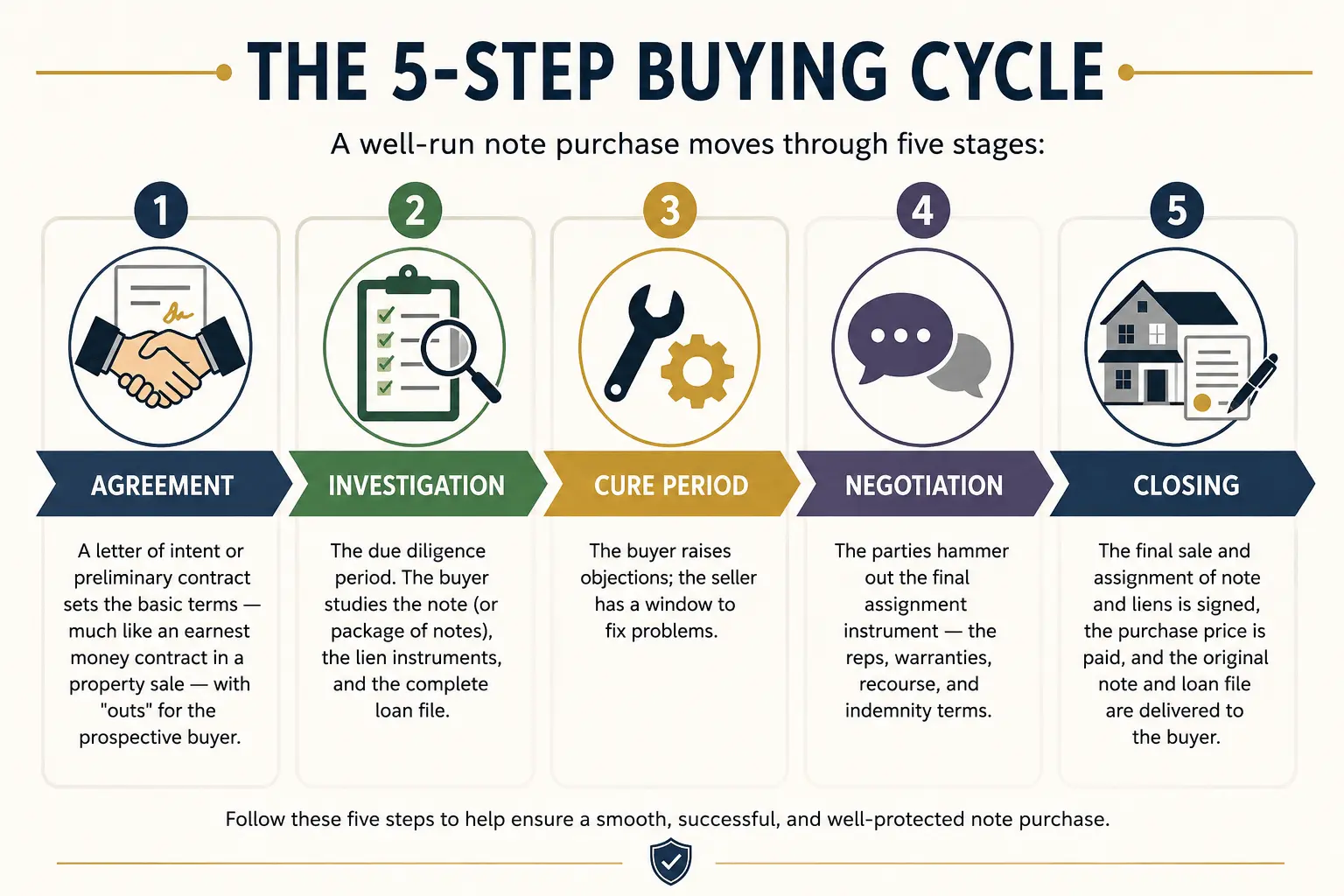
The 5-Step Buying Cycle
A well-run note purchase moves through five stages:
Agreement. A letter of intent or preliminary contract sets the basic terms — much like an earnest money contract in a property sale — with “outs” for the prospective buyer.
Investigation. The due diligence period. The buyer studies the note (or package of notes), the lien instruments, and the complete loan file.
Cure Period. The buyer raises objections; the seller has a window to fix problems.
Negotiation. The parties hammer out the final assignment instrument — the reps, warranties, recourse, and indemnity terms.
Closing. The final sale and assignment of note and liens is signed, the purchase price is paid, and the original note and loan file are delivered to the buyer.
Due Diligence Part 1: Verify the Paper
Verify validity and enforceability. That’s the core task, and it deserves an attorney’s eyes before substantial funds are committed. Insist on the whole loan file, not just a copy of the note: the note, the recorded deed of trust, the recorded deed into the borrower’s name, and the complete payment history. Even if you’re reviewing copies, the original note must exist and be available for inspection.
Your paper checklist — a note offered for sale should:
 The Money: Was the loan actually funded? A note requires real consideration — money actually loaned.
- The Math: Do the written words match the numerical figures? Are the repayment terms clear?
- The Signatures: Are they authentic and dated? If the property is a Texas homestead, are both spouses on the required documents?
- The Security: Is the note backed by a valid, recorded, unreleased deed of trust?
- The History: Is the payment record accurate and current? Is the note free of monetary and technical default?
- The Cleanliness: No usurious interest or illegal terms; no litigation or bankruptcy — existing, threatened, or anticipated; no third-party claims; and no prior sale or transfer of the note, in whole or in part.
Due Diligence Part 2: Verify the Property (and the Parties)
The paper is only half the picture. The collateral behind it is the other half. Play detective:
Existence: Is the house actually there? (You’d be surprised.)
Condition: Good repair — or flood-damaged and underwater in every sense?
Occupancy: Owner-occupied or tenants?
Taxes: Are property taxes current? Tax liens prime almost everything.
And verify the parties: if the seller or borrower is an LLC, corporation, or limited partnership, confirm it’s in good standing with the Texas Secretary of State and the Comptroller. An entity that’s lost its good standing lacks capacity to do business — including selling you a note.
Every one of these factors affects the quality of the note. And quality drives price.
Attorney Hamilton Rucker’s Perspective
Think of note due diligence as underwriting three things at once: the paper, the property, and the people. A beautiful note on a burned-out house is a bad note. A beautiful house securing a note the seller already sold to someone else is worse. I’ve seen both. Slow down, get the whole file, and verify independently.
“As Is” vs. Guarantees: Representations and Warranties
Picture a tug-of-war. The seller pulls toward “as is” — no refunds, no liability, no comebacks after closing. The buyer pulls toward warranties — assurance the note is valid, enforceable, and exactly as described. Where the rope settles is a matter of negotiation, and it shows up directly in the price.
A well-drafted assignment can include extensive reps and warranties, limited ones, or none at all (“as is,” almost always without recourse). Core seller representations a careful buyer wants:
The note and liens contain correct information and are legally valid and enforceable
The note is secured by a lawful vendor’s lien in a recorded warranty deed plus a valid first-lien recorded deed of trust
Payments are current with no monetary or technical default looming
No litigation is pending or threatened
The seller is the sole owner and holder with full power to transfer
If the note arose from seller financing: the SAFE Act and Dodd-Frank were complied with at origination
Also negotiate how long reps and warranties survive closing — 30 days? 90 days? Indefinitely? Silence invites disputes.
Two warnings. First, if you’re the seller, a one-liner “as is” clause won’t cut it — the clause must disclaim assurances about the note and about the condition and value of the underlying property. Second, if you’re the buyer: reps and warranties never substitute for your own due diligence. Most notes sell “as is.” Your investigation is your only real safety net.
Even in a pure “as is” deal, buyers should push for a full-disclosure covenant — an agreement that the seller will disclose, before the inspection period ends, all material facts about the note, the liens, and the property that could reasonably affect the decision to buy.
What If They Stop Paying? Understanding Recourse
Recourse answers the most important “what if” in note investing: what happens if the borrower defaults after you buy?
🛡 No Recourse (the cracked shield). You own the problem. If the borrower defaults, you’re solely responsible for collection and foreclosure. No-recourse notes trade at the biggest discounts for a reason.
🛡 Full Recourse (the gold shield). You can put the note back to the seller — typically for a refund/credit or a substitute performing note.
🛡 Limited Recourse (the silver shield). Everything in between, and contractually it’s all over the map: shared collection costs, post-foreclosure reckonings, caps on total recourse dollars, or batch provisions (e.g., in a 100-note package, the first 10 problem notes are full recourse, the rest are not).
One universal rule: recourse is almost never indefinite. Whatever recourse you negotiate, it will usually be bounded by a time period. Know exactly when your protection expires.

Indemnity, Disclosure, and Drafting the Assignment
Indemnity clauses shift the cost of future legal problems — sellers want protection from “comebacks,” buyers resist paying to defend someone else’s defects. Indemnities matter, but don’t over-rely on them: they aren’t self-executing. Nothing stops a borrower from suing both the old and new note holders, and the indemnity often just determines who wins the second lawsuit. A mandatory mediation clause is often a smart addition.
Drafting principles for the assignment itself:
It should be a comprehensive document. If an assignment of note and liens is one page long, something is missing. (Well-drafted assignments commonly run 10–20 pages.)
Everything express, nothing implied. No party should rely on anything that isn’t in writing.
Disclaim oral statements. Loose ends and unwritten assumptions are the raw material of future litigation.
Sealing the Deal: Endorsement, Delivery, and Recording
Three steps close a note purchase properly:
The Assignment Contract. Signed by both parties — a proper assignment is a mutual contract, not a unilateral transfer. It transfers the legal rights to the note and the liens.
The Endorsement. The seller stamps/signs the original note with appropriate wording (for example, “payable to assignee without representations, warranties, or recourse”) and the effective date. If there’s no room on the note itself, the endorsement goes on an allonge — a paper so firmly affixed to the note that it becomes part of it. Skipping proper endorsement can impair negotiability and leave the buyer a mere transferee instead of a potential holder in due course.
The Recording. The buyer should record the assignment in the real property records of the county where the security property sits — so prepare the assignment in recordable form. And the original note should be physically delivered to the buyer at closing.
The Investor’s Balance Sheet: Pros and Cons
Pros:
Passive income stream — payments arrive without property management
Secured by real estate — collateral you can foreclose on if needed
No tenants, no toilets
Cons:
The asset depreciates by design — every payment shrinks the balance, and a paid-off note is a finished asset. A stable portfolio needs continual replenishment with new notes.
Heavy due diligence required — the paper, the property, and the parties all need verification
Complex paperwork — assignments, endorsements, recourse, and recording must be done right
Unlike rental property, there’s no underlying equity appreciating over time. Notes are income instruments, not growth instruments — plan your portfolio accordingly.
Common Mistakes Note Investors Make
Buying a copy, not a note. Closing without the original note and complete loan file in hand.
Skipping the endorsement or the allonge. Impairing negotiability and giving up holder-in-due-course potential.
Not recording the assignment. Leaving the transfer invisible to the world.
Confusing price with value. A deep discount on an unenforceable note is 100% loss.
Missing the homestead signature issue. Texas homestead property generally requires both spouses on the security documents.
Ignoring entity status. Buying from (or through) an entity that isn’t in good standing with the state.
Treating “as is” casually as a seller. A simplistic one-line disclaimer invites litigation.
Assuming recourse lasts forever. It almost never does — calendar the expiration.
Buying non-performing notes without foreclosure-readiness. If the plan is to foreclose, the note and deed of trust must be bulletproof before you wire funds.
FAQ: Buying and Selling Real Estate Notes in Texas
1. What is a real estate note?
A real estate note is a borrower’s written promise to repay a loan — the I.O.U. — secured by a lien (usually a deed of trust) on real property. Buying the note means buying the right to receive the payments and, through the lien, the power to foreclose on default.
2. What’s the difference between the note and the deed of trust?
The note is the promise to pay; the deed of trust is the security that ties the debt to the property and provides the power of foreclosure. To fully “be the bank,” an investor needs both transferred: the note by endorsement and the liens by written assignment.
3. How do I buy a real estate note in Texas?
A typical purchase follows five steps: (1) agreement on basic terms, (2) a due diligence/investigation period, (3) a cure period for problems the buyer finds, (4) negotiation of the final assignment terms, and (5) closing — payment, execution of the assignment, endorsement, and delivery of the original note and loan file.
4. What is an assignment of note and liens?
It’s the legal instrument that transfers ownership of the note along with the liens securing it (the vendor’s lien and the deed of trust lien). It should be signed by both parties, comprehensive in its terms, and recorded in the county where the property is located.
5. What due diligence should I do before buying a note?
Verify the paper (funded loan, matching amounts, authentic signatures, both spouses on homestead documents, valid recorded deed of trust, accurate payment history, no defaults, no litigation, no prior transfers), verify the property (existence, condition, occupancy, taxes), and verify the parties (entity good standing). Engage an experienced attorney before committing substantial funds.
6. What does it mean to buy a note “as is”?
The seller makes no representations or warranties about the note or the underlying property, and the sale is almost always without recourse. “As is” notes trade at discounted prices, and your due diligence becomes your only safety net.
7. What is recourse in a note sale?
Recourse is your remedy against the seller if the borrower defaults. It comes in three flavors: none (you own the problem), full (return the note for a refund or a replacement performing note), and limited (negotiated cost-sharing or caps). Recourse rights are almost always time-limited.
8. What’s the difference between performing and non-performing notes?
A performing note has a borrower paying on time — bought for long-term cash flow. A non-performing note is in default — bought at a deep discount, often with the goal of acquiring the property through foreclosure. Non-performing purchases demand the most rigorous due diligence.
9. Is a real estate note a negotiable instrument?
Usually, if properly drafted: an unconditional promise to pay a fixed amount, payable to order or bearer, on demand or at a definite time. Negotiability brings favorable UCC rules and potential holder-in-due-course status. Non-negotiable notes can still be sold, but under ordinary contract rules and typically at a discount.
10. What is an allonge?
An allonge is a piece of paper firmly affixed to a promissory note used for endorsements when there’s no room on the note itself. A missing or defective endorsement can impair the note’s negotiability and downgrade the buyer’s legal status.
11. Can I sell my owner-financed note in Texas?
Yes. Sellers of owner-financed notes regularly sell them to investors for a lump sum. Expect the buyer to scrutinize the loan file — including whether the SAFE Act and Dodd-Frank were complied with at origination — and expect price to track the note’s quality, seasoning, and terms.
12. Do I need a lawyer to buy or sell a note?
Strongly recommended. Note transactions blend UCC law, real property law, foreclosure law, and contract drafting. An experienced attorney verifies enforceability, negotiates reps/warranties and recourse, and papers the endorsement, assignment, and recording correctly.
Key Takeaways
Note investing means buying the I.O.U., not the house — you own the financing, collect the payments, and handle zero maintenance.
You need both documents to be the bank: the note (promise to pay) and the deed of trust (the lien and the power to foreclose).
Two strategies: performing notes for long-term cash flow; non-performing notes at a discount, often to acquire the property through foreclosure.
A proper purchase follows the 5-step cycle: agreement → investigation → cure period → negotiation → closing.
Due diligence covers the paper, the property, and the parties — validity and enforceability are everything.
Most notes sell “as is.” Reps, warranties, and recourse (none / full / limited) are negotiated — and priced.
Close correctly: mutual assignment contract, endorsement (or allonge), delivery of the original note, and recording.
Notes are depreciating assets — a stable income portfolio requires continual replenishment.
Educate. Enlist an experienced attorney. Inspect everything. Start small. Welcome to the other side of real estate.
When to Contact a Lawyer
Bring in a Texas real estate attorney:
Before you commit funds to any note purchase — validity and enforceability review is the core of due diligence
When negotiating reps, warranties, recourse, or indemnity in an assignment
If you’re selling an owner-financed note and need the file cleaned up and the disclaimers drafted correctly
If a note you bought has gone into default and foreclosure may be next
If you discover defects after closing — missing endorsements, prior transfers, litigation, or lien problems
Before buying non-performing notes with a foreclosure strategy in mind
Contact Hamilton Rucker, PC — Protecting Your Rights
At Hamilton Rucker, PC, we represent Texas note investors, owner-finance sellers, and property owners in note purchases and sales, due diligence, assignments, and foreclosure matters statewide. Whether you’re buying your first note or managing a portfolio, get the paperwork — and the protection — right from the start.
 Call 713-589-2960 for a consultation, or connect online at HamiltonRucker.com.
This article is for general informational purposes only and does not constitute legal advice. Reading this article does not create an attorney-client relationship. Every situation is different — consult a licensed Texas attorney about your specific circumstances.