
Here’s a distinction that trips up more Texans than you’d expect: keys open the door, but the deed owns the house.
The keys mean possession. The deed means title — legal ownership. And in Texas, whether your deed actually transfers ownership, and whether that ownership is protected against the outside world, comes down to three specific steps. Miss one, and you may hold nothing more than an expensive piece of paper.
In this article, I’ll walk you through what a deed is, the three requirements for a valid Texas deed, why delivery is about control and intent (not paper-passing), why recording with the county clerk is the step that protects you against the world, and the formatting rules that get filings rejected at the clerk’s counter.
What This Article Covers
Watch the Video
Prefer to watch instead of read? Watch Attorney Hamilton Rucker explain this issue in detail here:
In the video, Hamilton breaks down the execute-deliver-record sequence, explains the “secret diary” problem with unrecorded deeds, and shows what happens when a dishonest seller tries to sell the same property twice.
What Is a Deed?
Short answer: A deed is the written rulebook that transfers ownership of real estate from the seller (the grantor) to the buyer (the grantee).
Two vocabulary words worth locking in, because every deed uses them: the grantor gives the rights away; the grantee receives them. The keys equal possession. The deed equals title — the actual legal ownership.
The Three Steps to a Valid Deed
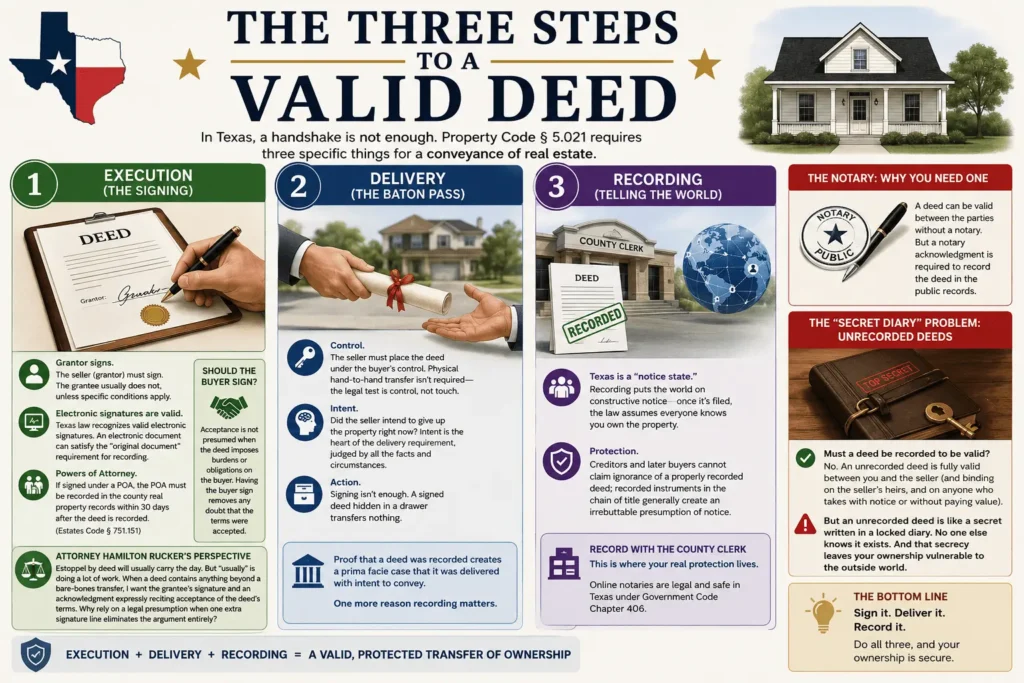
In Texas, a handshake is not enough. Property Code § 5.021 requires three specific things for a conveyance of real estate:
- In writing. A verbal transfer of land is not effective — period.
- Signed. Executed by the seller (grantor), the person giving the rights away.
- Delivered. Handed over — actually or constructively — with the intent to transfer ownership now.
Let’s take each step in turn, because each one has traps.
Step 1: Execution (The Signing)
The grantor must sign — they’re the one parting with rights. The grantee usually does not sign, unless specific conditions have been agreed upon (more on why a buyer’s signature can actually be a smart move in a moment).
A quick modern note: Texas law recognizes valid electronic signatures on real estate documents. An electronic document can satisfy the “original document” requirement for recording, and an electronic notary acknowledgment is valid without a physical stamp or seal.
When Someone Signs for You: Powers of Attorney
If a deed is signed under a power of attorney, Texas has a special rule: the POA itself must be recorded in the county’s real property records within 30 days after the deed is recorded (Estates Code § 751.151). That’s why POAs used for real estate should always be drafted in recordable form from the start.
Should the Buyer Ever Sign the Deed?
Traditionally in Texas, only the seller signs, and the buyer’s acceptance is simply presumed. But acceptance is not presumed when the deed imposes burdens or obligations on the buyer — and there’s case law holding that a deed never accepted by the grantee conveys nothing. When a deed contains custom clauses (an “as is” clause is the classic example), having the buyer sign and acknowledge the deed removes all ambiguity about whether those terms were accepted.
The Witness: Why You Need a Notary

Here’s a nuance that surprises people: a deed can be valid between the two parties without a notary. So why does everyone insist on notarization?
Because a notary acknowledgment is required to record the deed in the public records — and as you’re about to see, recording is where your real protection lives. And yes: online notaries are legal and safe in Texas under Government Code Chapter 406.
Step 2: Delivery (The Baton Pass)
Think of delivery like a relay race: the grantor has to actually pass the baton. Texas courts look at three things:
- Control. The seller must place the deed under the buyer's control. Physical hand-to-hand transfer isn't required — the legal test is control, not touch.
- Intent. Did the seller intend to give up the property right now? Intent is the heart of the delivery requirement, judged by all the facts and circumstances surrounding the transaction.
- Action. Signing isn't enough. A signed deed hidden in a drawer transfers nothing.
It’s about control, not just touch. You don’t have to physically hold the paper yourself — delivery to your agent (like a title company at closing) counts as delivery to you. If the intent was to finalize the deal, the property is yours.
One helpful presumption: proof that a deed was recorded creates a prima facie case that it was delivered with intent to convey. One more reason recording matters.
Step 3: Recording (Telling the World)
Now the big one. Texas is a “notice state.” Recording your deed with the County Clerk puts the whole world on what the law calls constructive notice — once it’s filed, the law assumes everyone knows you own the property. Creditors and later buyers cannot claim ignorance of a properly recorded deed; recorded instruments in the chain of title generally create an irrebuttable presumption of notice.
The "Secret Diary" Problem: Unrecorded Deeds
Must a deed be recorded to be valid? No — and this is where people get into trouble. An unrecorded deed is fully valid between you and the seller (and binding on the seller’s heirs, and on anyone who takes with notice or without paying value).
But an unrecorded deed is like a secret written in a locked diary. No one else knows it exists. And that secrecy leaves your ownership vulnerable to the outside world.
The Risk: Can They Sell It Twice?
Picture the nightmare scenario. You buy a property but never record your deed. The dishonest seller — who still appears to be the owner in the public records — sells the same property to a second, innocent buyer. That buyer checks the county records, sees nothing, and pays their money.
Who wins? In Texas, under Property Code § 13.001, the innocent buyer who records first could win the property — and you could be left with nothing but a lawsuit against a seller who may be long gone. Texas law protects the bona fide purchaser (BFP): someone who buys in good faith, pays valuable consideration, and has no actual or constructive notice of your unrecorded claim.
(The BFP rule cuts both ways, by the way. A last-minute transfer from a judgment debtor to his brother-in-law for “ten dollars and other valuable consideration” fools no one — courts require genuine good faith and reasonably equivalent value.)
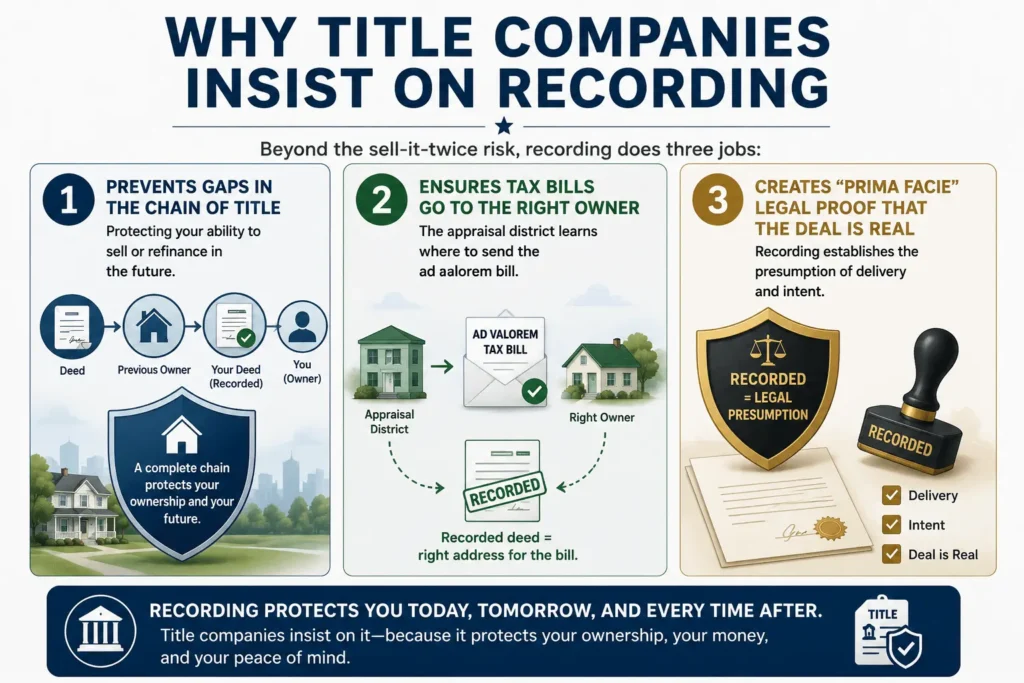
Why Title Companies Insist on Recording
Beyond the sell-it-twice risk, recording does three jobs:
- Prevents gaps in the chain of title — protecting your ability to sell or refinance in the future.
- Ensures tax bills go to the right owner — the appraisal district learns where to send the ad valorem bill.
- Creates "prima facie" legal proof that the deal is real — recording establishes the presumption of delivery and intent.
The Clerk's Checklist: Keep It Clean
The County Clerk can reject your filing (or charge penalty fees) if formatting rules aren’t met. For a document to be in recordable form, it generally must have:
- A one-inch margin at the top of each page
- A clear identifying heading or title
- Original signatures
- A notary acknowledgment for each signature, in each capacity
- Legible, reasonably readable text
- Each signer's name typed, printed, or stamped under the signature
- The grantee's (buyer's) address in the body of the document
Small stuff? Sure. But a rejected filing means days or weeks of delay — a window during which your deed remains an unrecorded “secret diary.”
Entering the Digital Age
Texas real estate recording has gone electronic:
- Texas law (the Uniform Electronic Transactions Act) allows e-recording.
- An electronic document counts as an "original" for recording purposes.
- Electronic notary seals are legally identical to rubber stamps.
Most Texas counties, including Harris County, now accept e-recorded deeds — which means there’s even less excuse for a deed to sit unrecorded in a drawer.
Common Mistakes
- Never recording the deed. Valid between the parties, invisible to the world — and vulnerable to a double sale.
- Assuming signing is enough. Without delivery — control plus present intent — a signed deed transfers nothing.
- Skipping the notary and then discovering the county clerk won't record the document.
- Failing to record a power of attorney within 30 days of recording the deed it was used for.
- Formatting failures — missing top margin, missing grantee address, no printed name under signatures — leading to rejected filings.
- Relying on presumed acceptance when the deed contains custom clauses the buyer never expressly agreed to.
- DIY deed forms from other states that don't meet Texas requirements (a theme regular readers will recognize).
Step-by-Step: Your Path to Secure Ownership
- Execute. Grantor signs the written deed — ideally before a notary in the same sitting.
- Acknowledge. Notarize every signature in every capacity (online notarization is fine in Texas).
- Deliver. Place the deed under the grantee's control with present intent to convey — delivery to the title company or closing agent counts.
- Record. File with the County Clerk of the county where the property sits — promptly. Confirm the document meets the clerk's formatting checklist.
- Verify. Pull the recorded instrument (most counties post records online) and confirm the recording data, legal description, and names are correct.
- File the POA too, if one was used — within 30 days.
Execute. Deliver. Record. A deed in hand makes you an owner; a recorded deed makes you a secure owner.
Frequently Asked Questions
What makes a deed valid in Texas?
Three things under Property Code § 5.021: it must be in writing, signed by the grantor (seller), and delivered to the grantee (buyer) with intent to convey. A verbal agreement to transfer land is not effective.
Does a deed have to be recorded to be valid in Texas?
No. An unrecorded deed is valid between the parties, their heirs, and anyone with notice. But it is void as to creditors and later good-faith purchasers who pay value without notice — which is why recording is essential protection.
What does "delivery" of a deed mean?
Delivery means the grantor places the deed under the grantee’s control with the intention that it operate as a conveyance right now. Physical hand-off isn’t required — delivery to an agent like a title company counts — but a signed deed kept in the seller’s drawer transfers nothing.
Does a deed need to be notarized in Texas?
A deed can be valid between the parties without a notary, but a notary acknowledgment is required to record it — and recording is what protects you against the outside world. Online notarization is legal in Texas.
What happens if I never record my deed?
Your ownership stays a secret. The seller still appears as owner in public records and could — illegally — sell to an innocent second buyer. In Texas, the good-faith buyer who records first can win the property, leaving you with only a lawsuit.
Is Texas a race, notice, or race-notice state?
Texas is treated as a notice state: recording gives the world constructive notice and establishes priority. A subsequent bona fide purchaser for value without notice of a prior unrecorded deed is protected under Property Code § 13.001.
What is a bona fide purchaser?
Someone who buys legal title in good faith, pays valuable consideration, and has no actual or constructive notice of a competing claim. Sham transfers for token amounts don’t qualify.
Who signs the deed — buyer or seller?
The seller (grantor) must sign. The buyer (grantee) usually doesn’t, but when the deed contains custom clauses — like an “as is” provision — having the buyer sign and acknowledge acceptance eliminates disputes later.
Can I record a deed electronically in Texas?
Yes. Texas authorizes e-recording under the Uniform Electronic Transactions Act; electronic documents count as originals, and electronic notary acknowledgments are valid without a physical seal.
What are the county clerk's formatting requirements for recording?
Generally: a one-inch top margin, an identifying title, original signatures, a notary acknowledgment for each signature, legible text, names printed under signatures, and the grantee’s address in the body. Miss one and the filing may be rejected or penalized.
What if a power of attorney was used to sign the deed?
The durable power of attorney must itself be recorded in the county’s real property records no later than 30 days after the deed is recorded (Estates Code § 751.151).
How fast should I record after closing?
Immediately — the gap between delivery and recording is exactly the window in which a dishonest seller can cloud your title or convey to someone else. Title companies record promptly for this reason; if you’re closing without one, make recording your same-day job.
Key Takeaways
- Keys = possession. Deed = title. A deed is the written rulebook transferring ownership from grantor to grantee.
- Three requirements for a valid Texas deed: in writing, signed by the grantor, and delivered with present intent to convey.
- Delivery is about control and intent, not physical paper-passing — but a signed deed hidden in a drawer transfers nothing.
- A notary isn't required for validity between the parties, but it is required for recording. Online notaries are legal in Texas.
- Texas is a notice state: recording puts the world on constructive notice and wins priority disputes.
- An unrecorded deed is a "secret diary" — valid between the parties but vulnerable to a bona fide purchaser who records first.
- Recording prevents chain-of-title gaps, routes tax bills correctly, and creates prima facie proof of delivery.
- A deed in hand makes you an owner; a recorded deed makes you a SECURE owner.
When to Contact a Lawyer
Talk to a Texas real estate attorney if: you’re transferring property without a title company (family transfers, investor deals, owner financing); you discover a deed in your chain that was never recorded; someone signed a deed under a power of attorney; you need custom clauses in a deed (as is, reservations, life estates); a seller may have conveyed the same property twice; or the county clerk has rejected your filing. Deed problems are far cheaper to prevent than to litigate.
Make Your Ownership Official — and Secure
At Hamilton Rucker, PC, we prepare, review, and record Texas deeds the right way — correct parties, correct capacities, recordable form, recorded promptly. Your deed is your shield; recording isn’t just paperwork, it’s the legal protection for your property today, tomorrow, and for your heirs.
This article is for educational and informational purposes only. It does not constitute legal advice or create an attorney-client relationship. Real estate transactions are fact-specific. Consult a qualified Texas real estate attorney about your situation.